
Knowledge
Biofeedback in pelvic floor training: how it works
Anyone who wants to train their pelvic floor faces a problem: you cannot see the muscles and often can hardly feel them. Biofeedback makes the invisible visible.
SmartMann editorial team · 13 October 2026 · approx. 5 min read
What is biofeedback?
Biofeedback literally means “feedback from the body”. Bodily processes that we normally hardly notice are measured with technical aids and made visible or audible in real time, for example as a number, a curve or a sound. This makes it possible to learn to influence these processes consciously.
Why is biofeedback useful for the pelvic floor?
The pelvic floor is a deep-lying muscle group. Many people cannot activate it deliberately at first and tense other muscles when exercising. Biofeedback shows immediately whether and how strongly the pelvic floor is actually working. This can help to
- find the right muscles and avoid mistakes when contracting,
- practise switching between contracting and relaxing,
- make progress visible and strengthen motivation,
- document the course of training for the therapist or doctor.
How is it measured?
There are various measuring methods. Probes or surface electrodes are often used to record electrical muscle activity (EMG) or pressure. Which method is suitable depends on the clinical question and the needs of the patient.
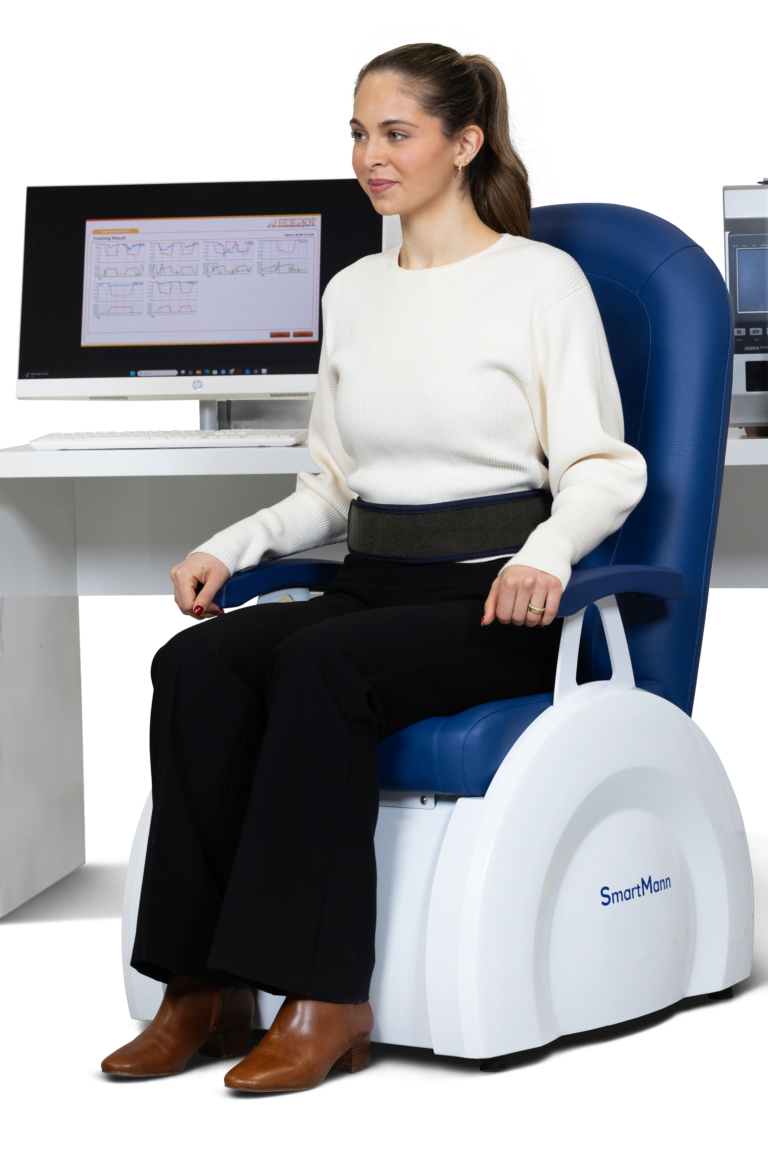
SmartMann systems take a bio-mechatronic approach: the seat records the muscle work from the outside. The patient remains fully clothed and no probe is used. For many people this lowers the threshold for starting training.
What does a training session look like?
- Take a seat: the patient sits on the device fully clothed.
- Instruction: an exercise target appears on the screen or in the app, for example short and strong or long and sustained contractions.
- Contract and relax: the pelvic floor is deliberately contracted and released again.
- Feedback: the measured force is shown immediately as a value and a curve.
- Evaluation: results can be compared over several sessions.
Who is biofeedback training suitable for?
Biofeedback-assisted pelvic floor training can be an option for women and men, for example with urinary or faecal incontinence, after childbirth or after surgery in the pelvic area. Whether and in what form it makes sense should be clarified by a doctor or physiotherapist. There are contraindications for certain situations, which are listed in the respective instructions for use.
Good to know
Biofeedback does not replace your own exercise; it is a tool that makes training more targeted. Regularity and patience are what count: building muscle usually takes several weeks.
Sources & further reading
- Cochrane Review (Herderschee et al., 2011): Feedback or biofeedback to augment pelvic floor muscle training for urinary incontinence in women ↗
- NIDDK (National Institutes of Health): Treatments for Bladder Control Problems ↗
- POGP – Pelvic, Obstetric and Gynaecological Physiotherapy: Pelvic floor muscle exercises for women ↗
The linked sources describe general medical background and are not product-specific evidence of effectiveness.
Biofeedback for hospital, practice and home
Discover the SmartMann systems HnJ-7000, HnJ-1000 and HnJ-350K.
This article is for general information only and does not replace medical advice, diagnosis or treatment. If you have symptoms, please consult your doctor.